Every session reloads. Nothing carries.
The whole file dumps back in, stale and entire. The agent quietly contradicts a past decision or trips a forgotten guardrail — and none of it traces back to you.
Built-in memory and CLAUDE.md are just notes — they reload whole, go stale, and don't track what you're working on.
Local-first · Free, open-core BSL 1.1 → Apache 2.0 · Claude Code · Codex · Cursor, via MCP
Open the desktop app and your brain is right there — local, single-user, yours. Scroll to walk the four surfaces an operator lives in.
The brain digests everything your agents shipped and writes it up: what moved, what got decided, what's waiting on you. You read three sentences, not a 400-line log.
brain journal · written on your schedule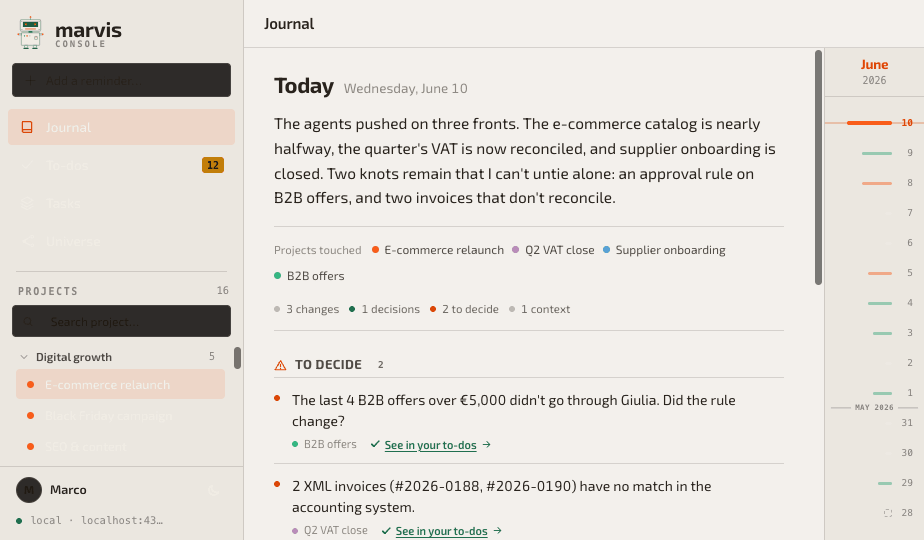
The brain bounces the calls only you can make to your queue — a price that doesn't match, a rule that changed: decide, approve, review, or delegate it back to an agent.
your queue · decisions chained to audit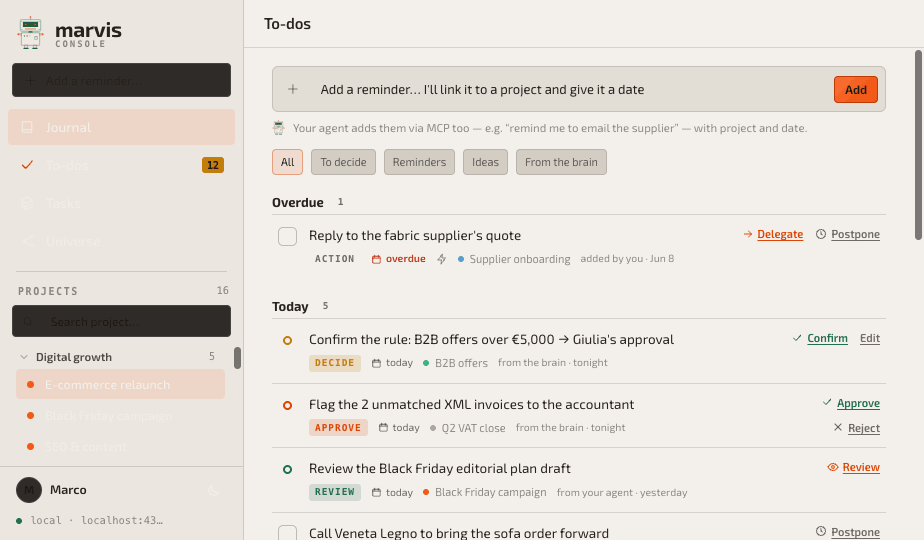
To do → In progress → To approve → Done. Agents own the work and push it back when it needs a yes. Every card carries its project, its ICE-D priority, and the brain's warnings.
kanban · agent + you, one queue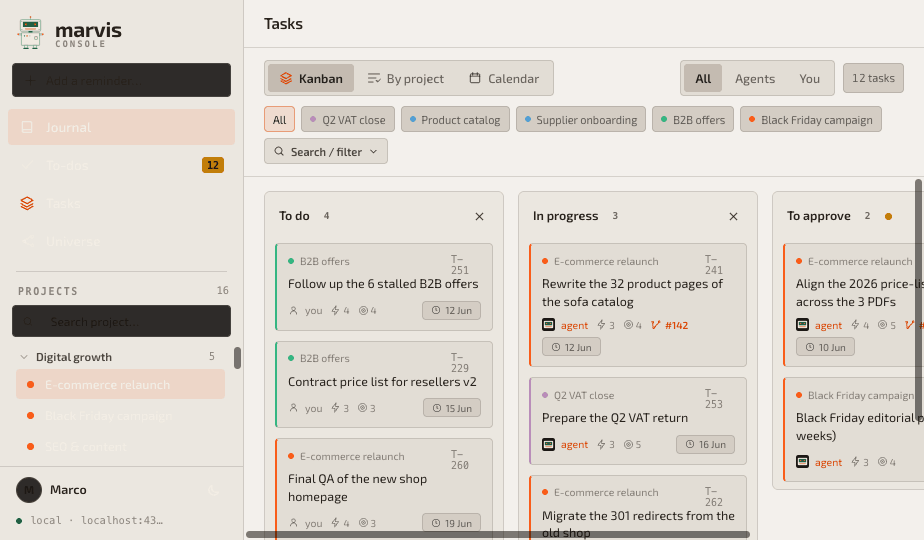
Open a project and the brain hands you its whole context: the journal, the decisions (and which superseded the last), what it knows, the docs, the people — not lost in Slack threads.
project brain · decisions · docs · people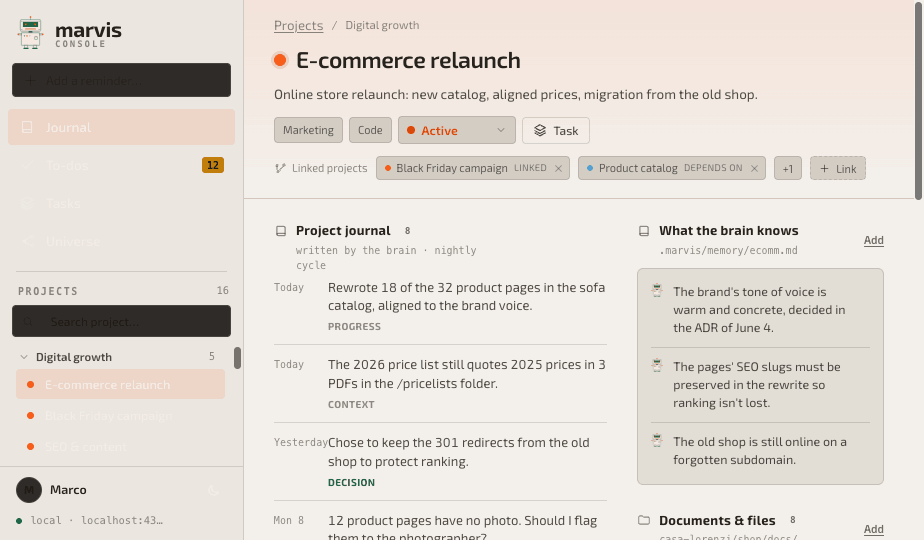
Projects, tasks, documents, decisions — linked across every repo. Ask "what breaks if I change this?" and get an answer that spans the company, not just the file in front of you.
knowledge graph · cross-project X-ray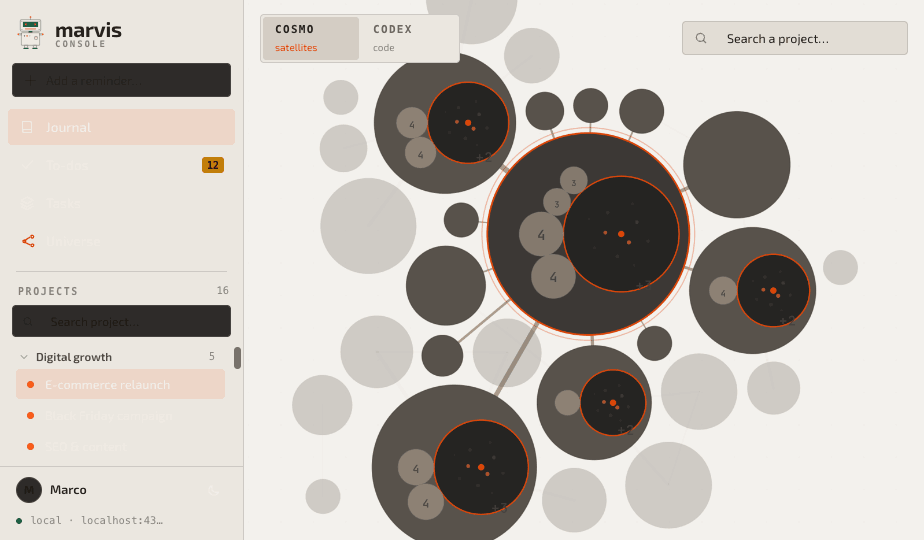
Your agent can recall facts. What it can't see is the state of things — what's in progress, what's blocked, what depends on what. So it reloads notes inside the session, and leaves a pile of disconnected docs around it.
The whole file dumps back in, stale and entire. The agent quietly contradicts a past decision or trips a forgotten guardrail — and none of it traces back to you.
Notion, Obsidian, a CLAUDE.md per repo — every tool stores whatever you dump in. None track what's in progress, or what breaks if it changes.
Your agent runs the wizard — no dashboard, no manual migration. Marvis lives inside the stack you already use.
From inside Claude Code, Codex, or Cursor — the same terminal you already work in.
$ claude run "install marvis from justaskmarvis.com"
Folder scaffold, governance hooks, MCP server. The agent updates its own CLAUDE.md / AGENTS.md so future sessions wake up brain-aware.
→ cloning marvis-harness …
→ updating CLAUDE.md, AGENTS.md
→ installing 5 governance hooks
→ wiring MCP server at .marvis/mcp.sock
✓ harness in place
Existing repos, decisions and transcripts — indexed into the graph, your constitution applied across every project at once.
→ scanning ~/code · found 12 projects
→ ingesting · 1,847 nodes · 4,212 edges
→ constitution applied to 12/12
✓ brain online
Every session reads the brain; every result writes back, tagged with your approval.
$ claude
› Brain: 3 unresolved decisions from last week.
› Brain: onboarding agent broke a rule — flagged.
› Brain: new learning extracted from 4 converged sessions.
› _
Same brain on every tier, on EU servers. Environments sleep after 15 idle minutes and wake on the first call. You pay for storage and compute, not promises. Upgrades keep your tenant: same data, no migration.
For companies that want AI to ship work — without giving up uptime, departmental separation, or where the data lives.
Your team's agents run server-side, not on laptops. No "my Mac died at 3am" stories. Reachable from anywhere, audit-logged everywhere.
Product knows what Sales decided. Engineering sees Compliance constraints. Departments share context without sharing everything. SSO, SCIM, role-based scopes.
Data stays on your servers, never ours. Run an in-house LLM, or BYOK against OpenAI, Anthropic, Mistral. No vendor lock-in on infra or model.
Every action chains back to the human who said yes. Logging and human-oversight requirements on by default. Your legal team writes policy; MarvisX enforces it.
Things people ask before installing.
You don't change tools. You don't migrate. You drop in one line and your stack wakes up with a brain.